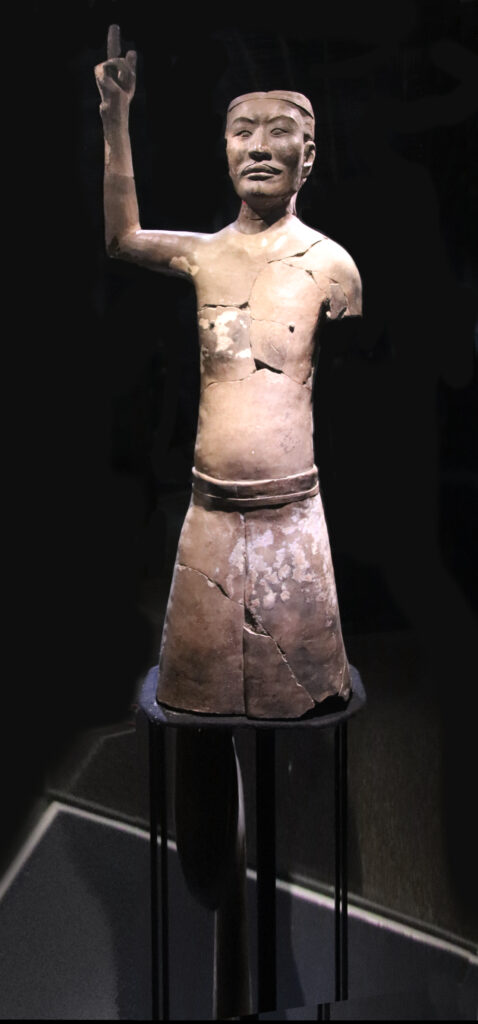
The Terracotta Army is famous for military ranks, but the mausoleum complex of China’s First Emperor contains a much wider cast of figures. Among the most surprising are the sculptures usually called acrobats or strongmen. Their bare or lightly clothed bodies, expressive poses, and carefully modelled limbs look very different from an armoured infantryman standing in formation.
These figures do not turn the Terracotta Army into a modern entertainment story. They are archaeological evidence from the wider Qin mausoleum landscape, and their exact roles are still interpreted with care. They do, however, make one point clear: the site was conceived as far more than a buried field of soldiers. It recreated aspects of an imperial world with many kinds of people, labour, skill, and ceremony.
Quick answer
- Are the acrobats part of the main Terracotta Army pits? No. They come from a separate burial pit in the wider mausoleum complex, not from the three principal warrior pits.
- Why are they called acrobats or strongmen? Their poses and bodies differ strongly from the military figures, and museum researchers consider that some may represent palace performers.
- Is that identification certain? It is an archaeological interpretation, so it is best described as a well-supported possibility rather than a programme listing for a specific performance.
- Can you always see them on a standard visit? Do not plan a day around one specific object. Displays, conservation, and viewing access can change.
- Why do they matter? They show that the First Emperor’s funerary landscape included more than weapons, ranks, and chariots.
The essential distinction: army pits and the wider mausoleum
The three main pits are the core visual experience for most visitors: military figures, horses, chariots, weapons, earth walls, and large formations. The acrobat and strongman figures belong to the larger mausoleum landscape around that famous army. Calling them “Terracotta Army acrobats” is convenient for visitors, but it should not erase that distinction.
This broader setting is the key to understanding the figures. The 1974 discovery guide explains how the famous find led to a much larger archaeological story, while the Qin Shi Huang mausoleum guide helps place the army within a wider day at the site.
What Pit K9901 may represent
Researchers have linked the figures from Pit K9901 with palace performance because they differ so markedly from the soldiers and civil officials found in other pits. The surviving figures include unusual postures and bodies that encourage viewers to think about strength, movement, and display rather than battle formation. The careful wording matters: “may represent” is more accurate than pretending that every gesture has one fixed explanation.
A report drawing on museum research describes a restored figure from K9901 as a possible acrobat and notes figures with standing and reclining poses. It also records that restoration and costume research continue. You can read the Xi'an government report on the K9901 acrobat research for that recent context.
Why these figures feel so different
An ordinary warrior is designed for a specific role in a larger formation. Armour, robe, hairstyle, stance, and the relationship to weapons all support that military reading. The acrobat and strongman figures shift attention to the body itself. Shoulders, chest, arms, hands, and posture become central visual information rather than details partly covered by armour.
That does not make the figures less carefully made. In fact, it gives visitors another way to appreciate the same extraordinary craft tradition. The guide to how the warriors were made explains the large-scale technical challenge behind these life-size ceramic figures; the acrobat figures reveal how varied the final results could be.
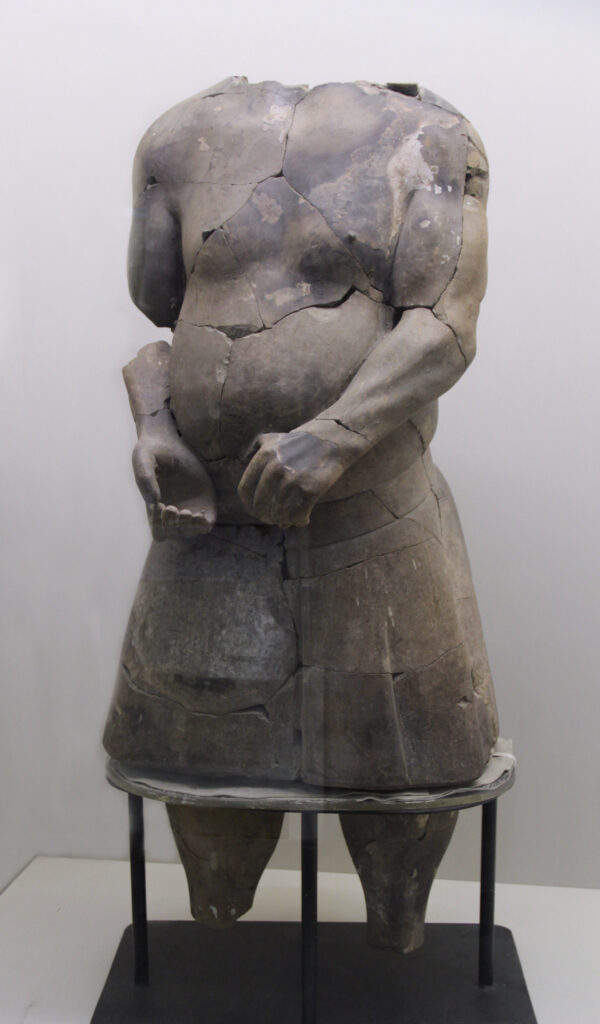
How to look at a strongman or acrobat figure
Start with posture. Is the body upright, twisted, reclined, or reaching? Then look at the hands and forearms. A hand can suggest an action even when the original setting or associated object is not fully known. Finally, look for joins, cracks, and repairs. These are not distractions from the sculpture; they are evidence of burial, excavation, and conservation.
This is a useful change of pace after looking at the army ranks. In Pit 1, scale and formation are the first things to absorb. In Pit 2, individual poses and types become easier to compare. A non-military figure helps make both experiences feel less repetitive.
What the close details can tell you
The close detail of an arm is particularly revealing. Muscle, hand position, and the transition at an elbow were deliberate choices made in clay, then subjected to burial and later restoration. You do not need to decide whether a pose depicts a precise exercise or act. It is enough to see that the artist was asked to make a body communicate something different from command, marching, or combat.
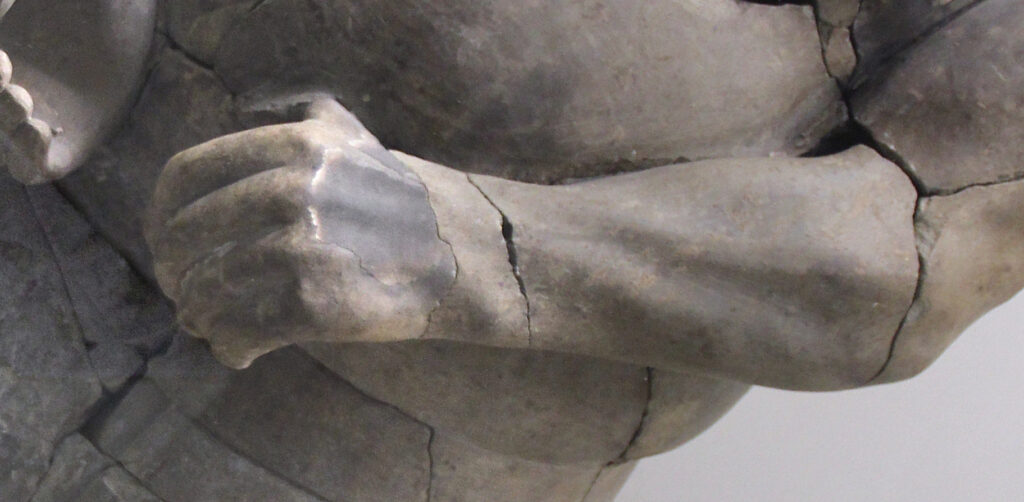
If close observation is what interests you, the restoration guide gives helpful context for breaks, joins, and reconstructed forms. The lost colours guide is a useful companion as well, because traces of surface treatment can change how a figure’s clothing and body were originally read.
Do not overstate the story
There are tempting headlines around these figures: that they prove a specific court show, that every pose has been decoded, or that they settle a much wider debate about artistic influence. A better visitor approach is more modest. The figures are unusual, they come from a separate part of the mausoleum complex, and specialists are still restoring and studying them. Their value is not reduced by that uncertainty; it is made more interesting.
The same restraint applies to the word “strongman.” It is a useful visual label for some powerful, minimally clothed figures, not a personal name or job title preserved on a museum ticket. Describe what is visible, use the museum’s current interpretation where available, and leave room for ongoing research.
A better way to connect this to your main visit
Begin with the first-time museum guide and the recommended route order. Let the main pits provide the essential experience. Then carry one idea with you: the soldiers are one element of an enormous funerary landscape. When you notice a different object, material, or figure type, ask what role it might add to that imagined world.
This perspective is especially useful for visitors who have already seen the famous photographs. Rather than trying to repeat the same images, look for evidence of variety: a horse, an official, a repair area, a pigment trace, a bronze object, or an unfamiliar human figure. The site becomes more memorable when it feels like a complex archaeological landscape instead of a single scene.
Why the acrobats matter to the archaeology
The figures are also important because they expand the material record used to study the Qin mausoleum. Archaeological research on ceramic craft technology has included samples from both warrior figures and terracotta acrobats, showing how questions of materials and production reach beyond the army itself. The published study of ceramic craft at the mausoleum is a useful reference for readers who want the technical background.
For most visitors, the practical conclusion is simpler: give unfamiliar figures the same attention you give the famous warriors. A less-known object can be the clearest reminder that the burial complex was designed as a world, not merely a military display.
Official checks before you go
Confirm current admission arrangements through the museum ticketing page and the Emperor Qinshihuang's Mausoleum Site Museum. The UNESCO listing for the Mausoleum of the First Qin Emperor gives the wider heritage context. Follow current staff guidance and on-site display information rather than relying on an older exhibition photograph.
Best recommendation
Use the acrobat and strongman figures as a mental reset after the military ranks. Notice one pose, one hand, and one repaired join. Then return to the main pits with a broader question in mind: what kinds of life, skill, and ceremony did the Qin court want this mausoleum landscape to preserve? That question adds real depth to a Terracotta Army visit without making the route more complicated.
Qin Civil Officials at the Terracotta Army: What Pit K0006 Reveals
Discover the Qin mausoleum civil officials of Pit K0006: why their folded sleeves, charioteers, colours, and separate setting…
Bronze Water Birds at the Qin Mausoleum: Cranes, Swans, and Geese
A visitor guide to the bronze water birds from the Qin mausoleum: why cranes, swans, and geese matter,…
How Terracotta Warriors Were Made: Clay, Molds, and Details to Notice
A clear guide to how Terracotta Army figures were made: prepared clay, repeatable production steps, hand-finished details, firing,…