The Terracotta Army was not meant to look grey. When the figures were made for the First Qin Emperor’s mausoleum, many carried painted surfaces over their fired clay bodies. Clothing, armour details, hair, faces, and other features could have appeared far more vivid than the earth-toned army visitors see today.
Most of that colour is now gone, which is why a first view of the pits can feel unexpectedly monochrome. That does not mean the original colour story has disappeared completely. Small traces, carefully preserved examples, and the modelling beneath the surface all give you a better way to understand what the army once looked like.
Quick answer
- Were the warriors originally painted? Yes. Their surfaces carried coloured decoration after the clay figures were made and fired.
- Why do most look grey or brown now? The painted layers are extremely fragile once excavated and exposed to a changed environment.
- Can you still see colour? Sometimes, but usually as limited traces rather than a complete bright uniform.
- What should you look for? Faces, collars, armour edges, hair, sleeves, and areas where the surviving surface differs from bare clay.
- Best visitor approach: treat the original colour as part of the story, then look closely at individual details rather than expecting a fully painted army in Pit 1.
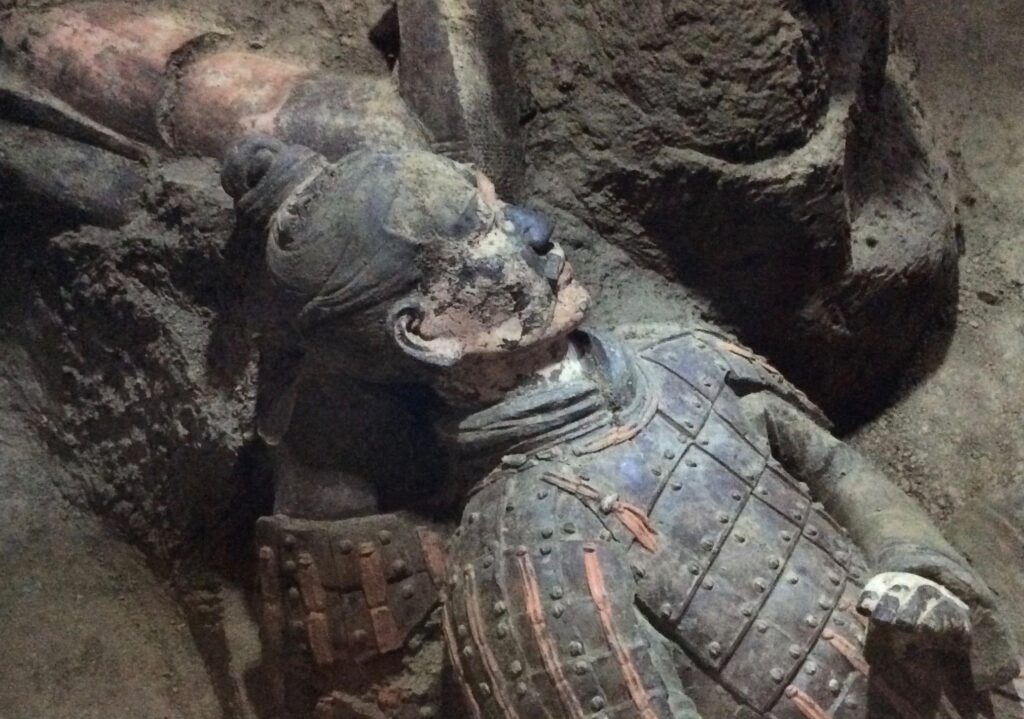
What the Terracotta Army originally looked like
Each warrior began as a carefully assembled clay figure, then received detailed finishing work. The original surface treatment added another layer of distinction. Instead of one uniform clay army, there would have been differences in costume, armour, hair, and painted features. The result was closer to a complex representation of a real force than a row of identical statues.
This is one reason the figures reward slow looking. The guide to faces, ranks, and small details is useful before you enter the pits: it shifts attention from the overall scale to the individual choices made on each figure.
Why did the colour disappear?
The paint layers on the figures were delicate. After more than two millennia underground, excavation changes the conditions around an exposed surface very quickly. The supporting layers can dry and alter, and paint that survived in the burial environment may loosen or flake away. That is why preservation work matters so much whenever new material is uncovered.
It is tempting to imagine that every warrior emerged from the ground looking like a modern museum reconstruction. In reality, colour loss can happen rapidly after exposure. What visitors see in the museum is therefore the result of both ancient craftsmanship and long-term archaeological care, not evidence that the original army was always plain clay.
What colours are still possible to notice?
Do not expect a single palette that is obvious from across a crowded hall. Surviving colour may appear as dark, red, greenish, bluish, or other faint areas, often on parts of a figure rather than over the entire body. Light, distance, glass, viewing angle, and the condition of the object all affect what you can make out.
A close view of a preserved figure makes the point more clearly than a panoramic pit photograph. Look at the face, the neck and collar, the armour panels, the sleeves, and the hair. These are the places where form and surface treatment work together.
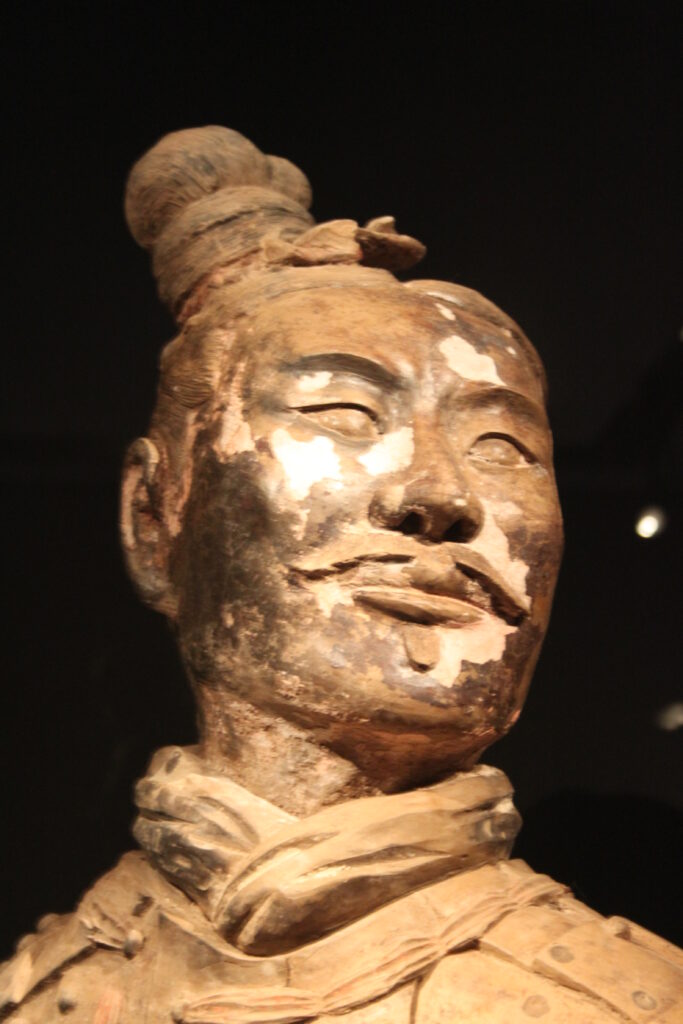
Where in the museum should you look?
Start with the main route rather than racing toward a single colour detail. The museum route order guide helps you protect the major views first. In Pit 1, take in the scale and formation, then use quieter moments at the railings to study nearer figures. The Pit 1 guide explains why this hall is still essential even when you are interested in close detail.
Pit 2 can feel more rewarding for visitors who want to think about roles, equipment, and archaeological detail. Read the Pit 2 guide before you go so the smaller-scale material does not become an afterthought after the spectacle of Pit 1.
How to look without slowing down the whole group
Use a simple two-pass method. On the first pass, understand the room, the line of sight, and the context. On the second, choose one or two figures or display cases and look for surface differences. This is more satisfying than scanning every statue for bright colour and also works better when the viewing rail is busy.
If you are visiting for the first time, pair this with the first-visit museum guide. It helps you keep tickets, route order, and the major pit sequence under control while still leaving space for details that make the visit personal.
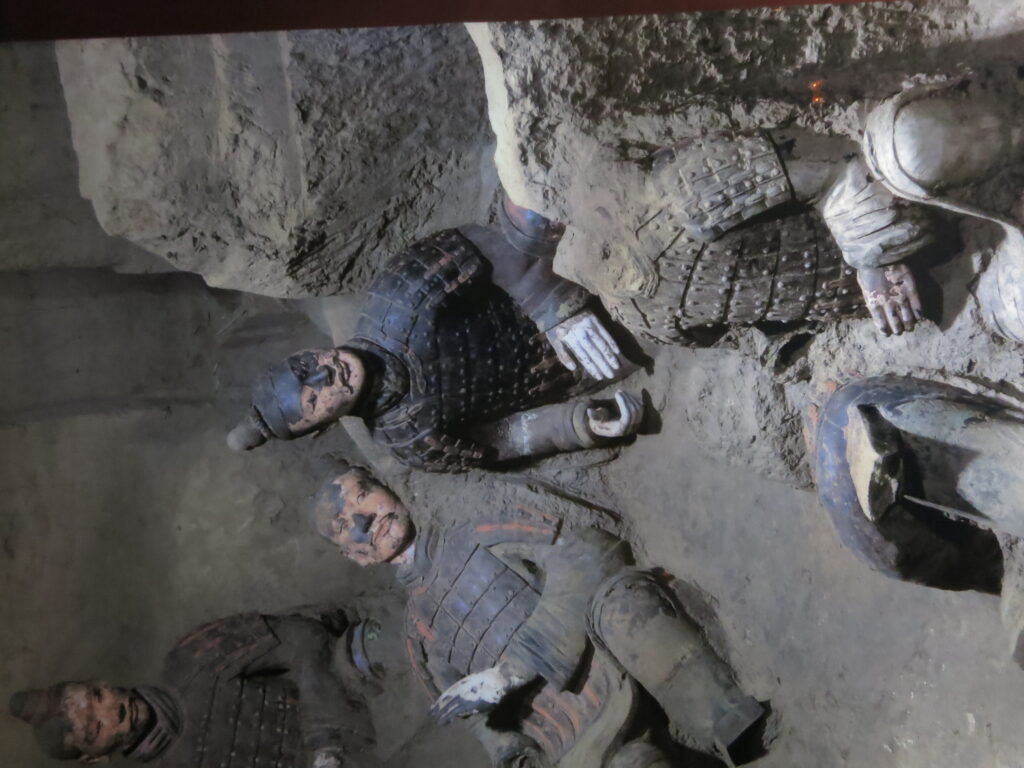
Photography: what helps and what does not
Colour traces are often subtle, so a distant mobile-phone image may not show what your eyes noticed. Avoid holding up the flow of visitors in search of a perfect close-up, and follow the museum’s current rules for photography, flash, and restricted areas. The Terracotta Army photography guide can help you make the most of permitted shots without turning the visit into a queue at the railing.
Would a guide or audio guide help with this?
For a visitor interested in colour, techniques, and small visual clues, some interpretation can be valuable. A good guide can point out context that is easy to miss in a large hall, while an audio guide lets you pause at your own pace. The audio guide versus tour guide comparison explains the practical tradeoff before you decide.
Do not confuse colour traces with a full reconstruction
Reconstructions, illustrations, and screen displays can be useful for imagining the original effect, but they are not the same as surviving pigment on an excavated object. Treat them as interpretation. In the real museum, the most meaningful experience is noticing how much information survives in a small patch of colour, a collar, a strand of hair, or an armour edge.
Official checks before you go
Confirm current visitor arrangements through the museum ticketing page and the Emperor Qinshihuang's Mausoleum Site Museum. The UNESCO listing for the Mausoleum of the First Qin Emperor gives the wider heritage context. On the day, rely on current museum signage and staff instructions for any display-specific photography or access rules.
Best recommendation
Go in expecting an archaeological site, not a brightly repainted spectacle. Once you know that the grey surface is the aftermath of burial, excavation, and preservation, the figures become more interesting. Take in the scale of the army, then slow down for a few individual details. The lost colours are not only a historical fact; they are a useful way to see the Terracotta Army more carefully.
Terracotta Army Weapons: What the Arrowheads and Swords Tell You
Look beyond the warriors themselves with a practical guide to Terracotta Army weapons: bronze arrowheads, swords, missing wooden…
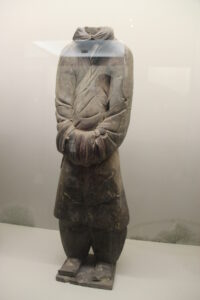
Qin Civil Officials at the Terracotta Army: What Pit K0006 Reveals
Discover the Qin mausoleum civil officials of Pit K0006: why their folded sleeves, charioteers, colours, and separate setting…
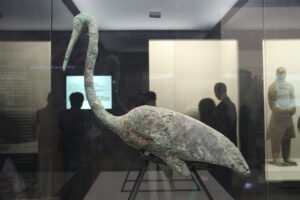
Bronze Water Birds at the Qin Mausoleum: Cranes, Swans, and Geese
A visitor guide to the bronze water birds from the Qin mausoleum: why cranes, swans, and geese matter,…