A helmet made from little stone plates is an unexpected thing to find beside the story of the Terracotta Army. For visitors curious about Qin military equipment, the stone armor from the First Emperor’s mausoleum offers a close look at how protective clothing could be represented for burial. The most useful starting question is simple: are you looking at something designed for a living soldier, or an object made for the emperor’s funerary world?
This guide focuses on armor and helmets associated with Pit K9801, a separate burial pit in the wider mausoleum complex. It explains the material, how to read the assembled pieces, and how to connect them with a visit to the warrior pits. The photographs show museum displays, not the equipment in its original buried position.
Before you look: four things to know
- Material: small limestone plates joined with metal wire, rather than a single carved stone shell.
- Context: burial equipment from the mausoleum landscape; K9801 is separate from warrior Pits 1, 2, and 3.
- Use: researchers consider stone armor unlikely to have been used in battle. Its shape can still inform discussion of contemporary protective equipment.
- Visit planning: treat this as an exhibit-reading guide. Check current displays before making a particular object the reason for an extra stop.
Why make armor out of stone?
The burial context is the key. The armor belongs to the material world prepared around the First Emperor’s tomb. A 2023 study of a Qin stone-armor workshop describes the K9801 excavation in 1998 and considers battlefield use unlikely. The stone objects followed forms of armor familiar at the time, but a recognizable shape is not proof of practical service.
That distinction matters when reading a museum label. An object can preserve information about the arrangement of protection around a body without proving that soldiers wore that particular material in combat. Avoid turning the display into a claim that Qin troops routinely marched in stone helmets, or that every warrior statue once wore one. The photographs and find context do not establish either conclusion.
The evidence also does not give us a personal explanation from the craftsmen for choosing stone. Funerary purpose is a useful interpretation; a detailed story about one emperor’s order, one workshop foreman, or a specific supernatural belief would need its own evidence.
Where does K9801 fit in the site?
The famous warrior formations and the emperor’s tomb form parts of a much larger archaeological landscape. K9801 is the identifier for the stone-armor pit, not another name for Pit 1. Keeping the numbers straight prevents a common misunderstanding when switching between a museum map, a book, and exhibition labels.
If you are deciding how to divide your day, the mausoleum visit guide explains the wider area. The main warrior pits remain the priority for a first visit. A reference to K9801 on a label tells you where an object came from; it does not by itself tell you whether that excavation is accessible on the day you travel.
How to read a suit of stone armor
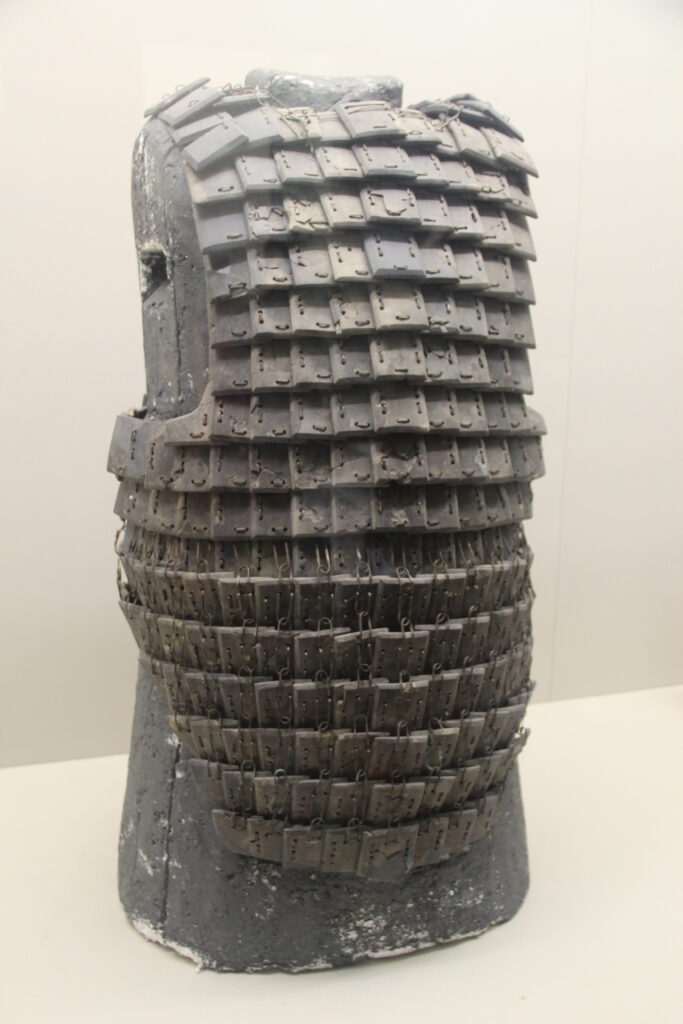
Look at the silhouette first. Find the neck opening, the edges around the arms, and the transition toward the lower body. Then follow a row of plates from side to side. This is easier than trying to count every small piece, and it shows how an assembled surface takes on the outline of protective clothing.
The museum’s catalogue entry for a stone armor and helmet set describes blue-grey limestone that was worked, drilled, and joined with bronze wire. It records 612 plates for the listed armor and 72 for the helmet. Those are counts for the catalogued objects, not a universal formula for every suit or helmet from the site.
At close range, distinguish three things: the surviving stone plates, the connections between them, and the support used to hold the object for display. In the photographs here, a backing gives the armor a readable body shape. It is useful for seeing the whole arrangement, but it should not be mistaken for an ancient wearer preserved inside it.
The small holes deserve your attention
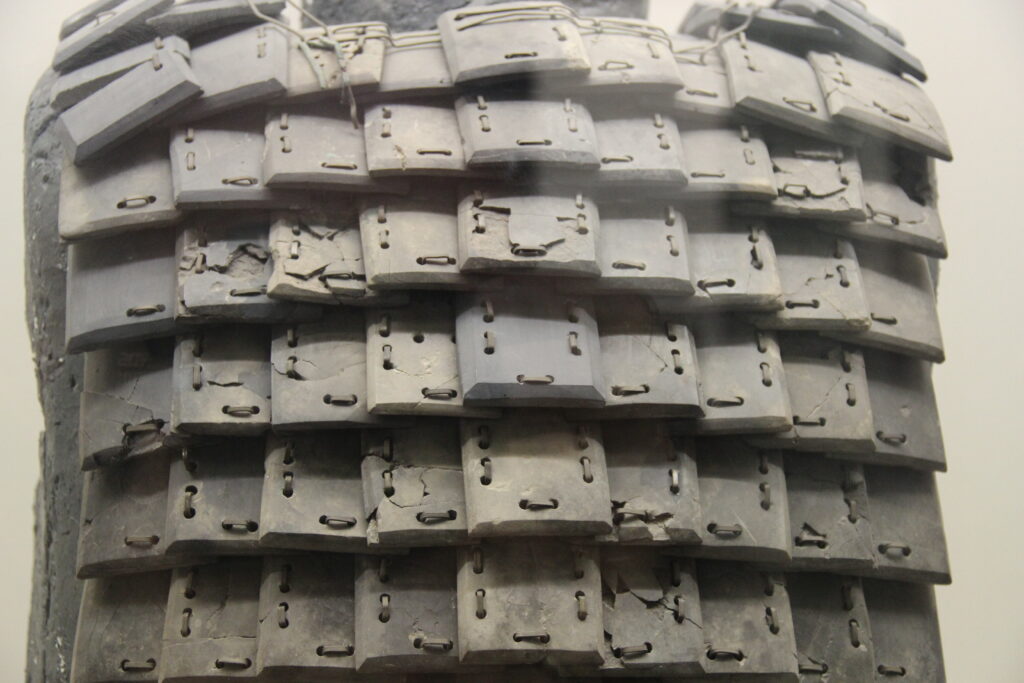
Once you have understood the overall shape, choose a short section of the surface. Look for holes near the edges, wire passing between plates, and places where one row overlaps another. These are more informative than the general grey color. They show that the appearance depends on many separately prepared components fitting together.
The workshop study reports unfinished pieces, tools, and production waste alongside more complete plates. That is a different kind of evidence from an assembled display: it helps researchers investigate stages of manufacture. For visitors, one useful comparison is between a finished edge and a fractured one. Do not identify every irregular mark as an ancient tool mark; breakage and later treatment also change surfaces.
What the helmet adds
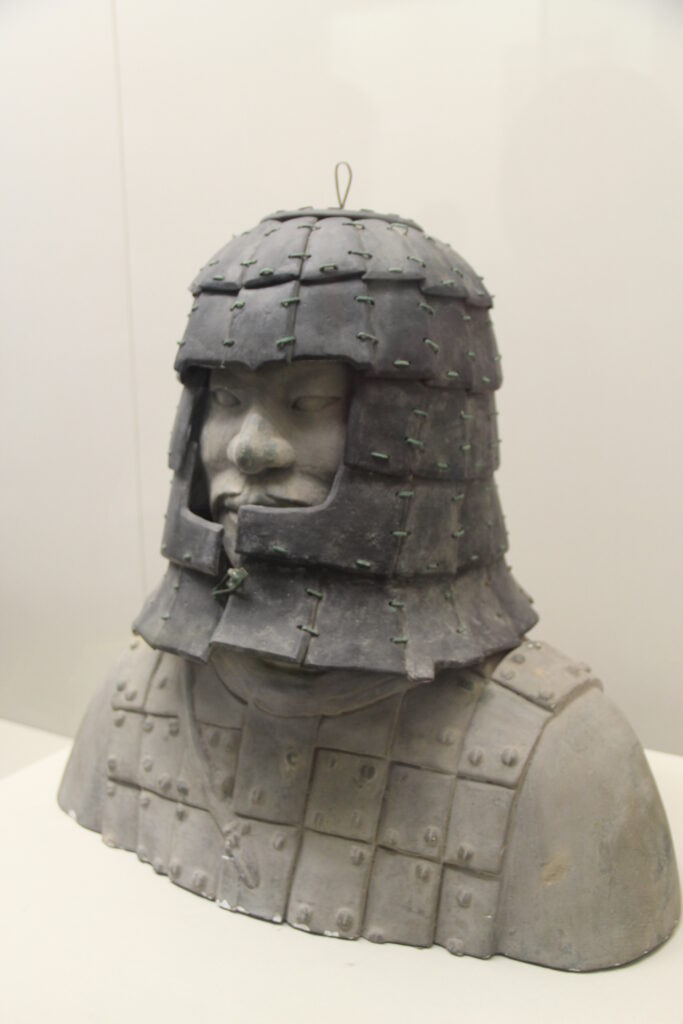
The helmet brings the same principle around a more complicated shape. Follow the plates over the top, down beside the face, and around the lower edge. Instead of treating it as a single solid object, notice the succession of smaller surfaces. The face opening is a good place to see how the edge of the assembly was arranged.
Our first photograph shows a helmet mounted over a bust. Read the mount as a display aid. It helps a viewer picture the relationship between head and helmet, but it is not evidence that this precise combination was excavated together. This distinction is especially useful when a photograph circulates without its museum caption.
Compare it with armor modeled on a warrior
On a terracotta figure, armor is part of the modeled ceramic surface. In the stone display, the plates are individual components assembled into a garment-like form. Looking at both helps you separate the appearance of armor from the material used to represent it.
During a visit, choose one clearly visible warrior and look at the shoulder coverage, chest pattern, and lower edge of its armor. The guide to details worth noticing provides other observation prompts. This is a visual comparison, not a way to assign a precise rank from one photograph. For the objects held or used by soldiers, the weapons guide covers a separate body of evidence.
Why a restored display looks different from an excavation
Standing armor in a case is immediately readable. Buried fragments are much harder to interpret. Reed College’s conservation image collection groups K9801 excavation views, scattered plaques, and assembled armor and helmet images. Comparing those kinds of views helps explain why the finished museum presentation is only one stage in an object’s history.
Look carefully at cracks and missing sections without assuming that every visible connection is untouched ancient material. A display photograph cannot establish the treatment history of each piece. If reconstruction interests you, the Terracotta Army restoration guide explains questions to ask about surviving fragments, joins, and supports.
Using this guide on a day trip from Xi’an
Follow your main museum route first, then use any relevant display to make one focused comparison: a whole suit, a plate connection, and the helmet’s face opening. This short observation exercise is a suggested way to look, not an additional attraction that requires a fixed block of your day. Families can turn it into a question: how many separate pieces can you spot before the whole shape becomes clear?
Before leaving Xi’an, consult the museum’s current visitor information and check on-site signs for exhibitions and access. Historical photographs do not guarantee today’s display. If your time or walking energy is limited, keep the main pits as your priority rather than rushing between areas to find one photographed object.
For getting there and returning to the city, use the Xi’an transport guide. The stone armor adds a question to carry into the museum: how did different materials help represent the emperor’s world? Even a brief look at one drilled plate can make the answer more tangible.
Photographs: Gary Lee Todd, Ph.D., via Wikimedia Commons, CC0. Separate photographs show the helmet, armor, and plate detail. Display arrangements may have changed since the photographs were taken.
Qin Civil Officials at the Terracotta Army: What Pit K0006 Reveals
Discover the Qin mausoleum civil officials of Pit K0006: why their folded sleeves, charioteers, colours, and separate setting…
Bronze Water Birds at the Qin Mausoleum: Cranes, Swans, and Geese
A visitor guide to the bronze water birds from the Qin mausoleum: why cranes, swans, and geese matter,…
Terracotta Army Acrobats and Strongmen: The Figures Beyond the Soldiers
Meet the Qin mausoleum acrobats and strongmen: why they are different from the Terracotta Army soldiers, what Pit…